Showing posts with label foreclosure. Show all posts

Thursday, September 15, 2011

foreclosure auctions


Invest Now Cover by adawnjournal


You've without doubt seen them or examine them. Glossy ads or four-color propagates in publications and newspapers promising to instruct you all of the juicy information regarding successful real-estate investing. And all you should do to learn every one of these real estate investing surface encounters chuck russo secrets is to pay a rather high sum for a one-or two-day seminar.


Often these types of slick real estate investing seminars claim that you could make smart, profitable real estate investments with simply no money lower (other than, of program, the large fee you purchase the workshop). Now, how attractive is that? Make a profit from real est investments you made out of no funds. Possible? Not likely.


Successful owning a home requires cash flow. That's the character of almost any business or even investment, especially property investing. You put your hard earned money into something that you hope and plan can make you more money.


Unfortunately too few newbies for the world of property investing believe that it's a magical form of business exactly where standard business rules don't apply. Simply set, if you would like to stay in real estate investing for more than, say, a day or two, then you're going to have to come up with money to use and commit.


While it might be true that buying real estate with absolutely no money down is easy, anyone that is even made a basic owning a home (such as buying their own home) is aware there's much more involved in real estate investing that will set you back money. For example, what about any necessary repairs?


So, the number one rule people not used to real property investing ought to remember is to have obtainable cash stores. Before you determine to actually do any property investing, save some money. Having just a little money inside the bank when you begin real est investing surface encounters chuck russo can help you make more profitable real estate investments in rental properties, for example.


When property investing in rental properties, you'll want to be able to select simply qualified tenants. If you might have no income when property investing within rental qualities, you could be pressured to take a less qualified tenant because you need somebody to pay you money so that you can take attention of maintenance or lawyer fees.


For any kind of real est investing, meaning leasing properties or properties you get to resell, having money reserved can enable you to ask to get a higher price. You can ask for a higher price from your real estate investment because a person surface encounters chuck russo won't feel financially strapped as you wait for an offer. You won't be backed into a corner and forced to accept just any offer because you desperately need the money.


Another downfall of many new to real estate investing is actually, well, greed. Make any profit, yes, but do not become therefore greedy that you ask for ridiculous leasing or resell rates on all of your real property investments.


Those not used to real est investing have to see real estate investing as a business, NOT a hobby. Don't believe that real property investing is going to make you abundant overnight. What business does?


It takes about 6 months to figure out if real-estate investing set for you. If you've decided which, hey I love this, then provide yourself a couple of years to really start making money. It typically takes at minimum five years to get truly productive in property investing.


Persistence may be the key in order to success in property investing. If you've decided that real-estate investing is perfect for you, surface encounters chuck russo keep plugging away at it and the rewards will be greater than you imagined.


It is very difficult to determine the sex of a pigeon. I used to keep pigeons as a kid so I’m good at it.


There are three ways to do it:


1 – Check their reproductive organs

Pigeons genitalia all look the same (they have ‘cloaca‘) so you will have to cut them open to actually see their reproductive organs. Not a very efficient method.


2 – See who goes on top

There isn’t much variation in the sex life of a pigeon. Males go on top. No Kama Sutra here. Fortunately all they do is eat and, ehm, reproduce. You won’t have to wait very long to see that happen. But you do need 2 pigeons and some patience.


3 – Look at their faces

Yes, pigeons have faces just like humans.


It takes years to be able to read the face of a pigeon. I kept pigeons as a kid so I can tell the sex of any pigeon just by looking at their faces for few seconds. Just like with most humans. Humans have the added benefit of clothing, hair and breasts. But even without that a face looks feminine or masculine.


Investors try to look under all those feathers but up close all excel sheets look the same. They try to see who goes on top but then you would have to wait until the entrepreneur meets an actual client.


But once you have met enough starting entrepreneurs one look at someones face is usually enough. You know what you have got and who is a good bet and who isn’t.


Just like with pigeons.


This is a variation of post I published in 2007. Photo credit: Igor Stevanovic via Shutterstock.


Warren Buffett just announced that he's making a landmark investment, $5 billion, in Bank of America.


Bank of America was facing a free-falling stock price and a number of criticisms, including that it did not have enough capital, and that its assets were not worth what it claimed.


Now thanks to Buffett, that will certainly change.


When similar investments were made in Citi and in Goldman Sachs, by Prince Alwaleed and Warren Buffett, in 1990 and 2008, respectively, the stocks experienced long term gains. 


And get this - he says he dreamt up the idea to invest in Bank of America in the bathtub on Tuesday. He liked it, so he called Moynihan on Wednesday morning. The entire story of how it happened is available in a video embedded below, as told to Becky Quick by Buffett.


The story (and the mental image) is amusing but also important - it suggests that the Obama Administration and/or the Treasury, did not have a hand in the agreement.


And to make it very clear that Treasury or Obama had no hand in the arrangement, which makes the news even better for Bank of America.


So does this - the deal is expensive for Buffett, and a good deal for Bank of America. He says in some ways, it's better than the deal he gave to Goldman Sachs in 2008.


But obviously, it's a great deal for Buffett.


Buffett's investment alone is now worth $700 million more than it was when he bought it.


Thursday, September 9, 2010

foreclosure


The great American Dream of owning a home has never looked so impossible to achieve: roughly 1.65 million homes are in the foreclosure pipeline, housing prices are at an all-time low, and nearly 7% of mortgage holders are more than 60 days late on their payments. Despite the dreary picture, there are an ever-increasing number of lifelines for people trying to avoid foreclosure:


One of the biggest national hotlines for free home counseling is 888-995-HOPE, run by the Congress-funded Home Preservation Foundation. To date, the HOPE hotline has counseled four million homeowners since 2008, and helped 70% avoid foreclosure within a year. HOPE is the number to call before you seek a loan modification or expensive legal representation: a counselor will listen to your housing and financial concerns and, if necessary, facilitate a three-way conversation with a third party for additional help. With 550 employees stationed in 8 centers around the country, Diane Zyats, VP of Communications at the Homeownership Preservation Foundation, says there is rarely a backlog of homeowners waiting to receive advice. This, Zyats stresses, is key to preventing a distressed homeowner from falling for one of the many foreclosure scams out there.


The HOPE website also offers this helpful list of warning signs of a scam. Foremost? "No one should charge," she says. "There are so many sources for not charging that there is no reason to charge." Click here to see more.


NeighborWorks America is another Congressionally-funded program that provides financial and technical support to community-based foreclosure prevention efforts, such as the National Foreclosure Mitigation Counseling Program (NFMC), which boasts a 60% success rate. It also manages this exhaustive database of certified, HUD-approved foreclosure counselors by state.


At a local level, many communities are showing an incredible display of humanity and compassion for their neighbors facing foreclosure. For example, the non-profit Brooklyn Volunteer Lawyers Project is a coalition of 80 Brooklyn-based lawyers serving low-income Brooklynites on a pro bono basis. Although volunteers receive credited continuing legal education (CLE) training, taking on a case can take up a huge chunk of time. For example, foreclosure cases take anywhere from three months to years and usually require multiple court appearances and ongoing counsel. But Jamie Lathrop, director of foreclosure intervention, sees it as a simple matter of civic duty, "Why help? These people are our neighbors. They keep our neighborhoods clean, watch our kids on the street, return our mail to us. They let us know when someones scratched our car," he says. "It's part of being in a community."


Currently the BVLP handles over 160 active foreclosure cases, and has successfully prevented 45 from final foreclosure through mediation. Brooklyn is one of an increasing number of areas around the country where mediation has become mandatory before a home can be foreclosed on. Although victims don't need legal representation at these settlements, it can provide an immense amount of reassurance.


Over in Philadelphia, the Residential Mortgage Foreclosure Diversion Program is often touted as the first successful city-sponsored foreclosure prevention plan. Under the compassionate eye of Judge Annette Rizzo, recipient of the 2009 Louis J. Goffman Award, this two-year-old program makes it mandatory for borrower and lender to meet face-to-face, and discuss every possible option before the home can be foreclosed on. These options include forbearance, settlement, stay of sale, loan modification or reinstatement, and as a last resort, a "graceful" exit.


August 20th, 2010 1:42 pm ET

There are an awful lot of people who post on here every day who seem quite content to blame the President for everything from the economy to the fact that it's raining at their house. Seriously folks .. ..you aren't taken seriously when you are so consistent in your hatred. Try, just once, to look at the bigger picture. Nothing happens in a vacuum. The country didn't start down this path of economic failure the day President Obama took office! There are many, many reasons for it spanning decades of bad management by our elected officials . . . . from both parties! Can't you, just once, acknowledge the fact that the current President was handed a country in deep crisis and that he is working to turn things around but that it is going to take more than the two short years he's been in office? Can't you, just once, acknowledge the fact that turning it around is going to take the cooperation of both parties in Congress and that one party isn't acting in good faith? Can't you, just once, acknowledge the fact that the Repubs have done nothing except obstruct legislation which could, and in many instances would, help turn things around simply because they believe if the status quo is maintained some voters (you all) will be so pissed off that your knee-jerk reaction will be to vote them back in again? All of the disparaging names and insults you spew at and about the President don't show you to be patriotic or smart. All it does is make you sound childish and bigoted.


eric seiger

Betaworks and The Times Plan Social <b>News</b> Site - NYTimes.com

Something is stirring deep within the technology incubator Betaworks: A personalized news service called News.me that is being developed in collaboration with The New York Times.

Defining Normal In The Brain - Science <b>News</b>

Scans set standard for how connectivity evolves during maturation.

Arrowheadlines: Chiefs <b>News</b> 9/9 - Arrowhead Pride

It begins tonight, and Kansas City Chiefs fans across the globe will wait. I'm so ready for football, I could run through a wall and rip someone's head off. Anyway, while we wait for our game on Monday, the Saints and Vikings kick ...


Tuesday, July 27, 2010

foreclosure help


This is part of my What Happened to ACORN series.


Last week a group called New York Communities for Change (NYCC) joined with New York City Comptroller John Liu and seven of New York's largest unions to demand that Wall Street's biggest banks reform their loan modification policies so families facing foreclosure will not lose their homes. If other groups follow that lead, we might make a big dent in the foreclosure crisis.


NYCC and its sister organization, Mutual Housing Association of New York, have been working with foreclosure victims neighborhoods like St. Albans in Queens, or Bed-Stuy in Brooklyn not far from Wall Street, where homeowners have been forced to make impossible choices: keep up their skyrocketing mortgage payments or provide their families with food and clothing.


Members of the group are angry at banks, who have been painfully slow to offer loan modifications, or simply refuse to lift a finger to help vulnerable families and neighborhoods to avoid foreclosure. Some banks often screw homeowners by sending numerous requests for already-submitted documents, and then foreclose on the hapless homeowner because the banks falsely claim that they never got those same documents!


The federal government's attempt to solve the foreclosure crisis has failed. In 2009, 50,000 foreclosures swept New York state, with nearly half in NYC. Across the country the crisis is getting worse, not better. Katrina vanden Heuvel on July 15, in the Nation, reported that New York City foreclosures rose 16 percent in the first quarter of 2010 compared to the same period last year, with "...over 265,000 mortgages -- 13 percent of the mortgages in New York State-are now past due or in the foreclosure process. Meanwhile, banks have made less than 12,000 permanent modifications in the state since May 2009."


After several community meetings it became clear that many NYCC and union members need their mortgages modified because they are underwater or delinquent. The community and labor groups put together an action plan with Comptroller Liu, SEIU 32BJ & 1199, United Federation of Teachers, TWU, DC37, RWDSU, and the NY Hotel and Motel Trades Council.


To start they will send a letter to Citigroup, JPMorgan Chase, Bank of America and Wells Fargo, criticizing them for dragging their feet and demanding they do "everything possible" to avert foreclosures, including mortgage modifications.


At a July 13th, press conference, Michael Mulgrew, President, UFT, said he has brought the issue to the pension funds and they will consider all options. John Samuelsen, President, TWU Local 100 said that "since he was on the board of the city pension fund, he would ask that the bank's response be one of the ways in which they evaluate where they put their money." NYCC member, Jean-Andre Sassine, caught in the mortgage bind, said, "if the big banks won't listen to homeowners, we thought that they should hear from some of their biggest investors -- the city, the unions and their pension funds."


If the banks fail to act, all parties involved could move their pension funds and bank deposits to other institutions. That is why the groups call their plan the Move Your Money campaign.

They claim it will not only modify foreclosures and save homes, it will hold big banks accountable to the community where they take deposits and profit from government supported loans. After foreclosures, neighbors who remain behind suffer from declining property values, and local and state revenues plummet, contributing to a stagnant economy and high unemployment. The coalition is demanding answers by September 1.


Thus far the Obama administration plan -- which relies on a voluntary mortgage modification program -- has not worked, forcing New Yorkers to take matters into their own hands.

The groups put Wall Street on notice that unless the banks increase the number of modifications, including principal write-downs, expedite the modification process and stop foreclosure proceedings while applications are being reviewed, the group will increase the pressure. "This is just the first step in a campaign to win loan modifications that stop preventable foreclosures. We're saying it loud and clear - if the banks won't listen, it's time to move our money," Jon Kest, NYCC's executive director.


What happened to ACORN?

It is a rare showing of both money and people power, with the unions representing over 500,000 working families. NYCC is a coalition of low- and moderate-income working families fighting for social and economic justice throughout New York State and includes some of the leaders and organizers from the now defunct ACORN. The group also uses many of the same tactics and strategies. NYCC's members and leaders hope the action taken by New York City's Comptroller and labor leaders will lead to a dramatic shift in how the banks deal with borrowers.


Civic leaders across the country should follow the coalition's lead. Either big banks become part of the solution or the rest of us will have to Move the Money.


You can buy a copy of John Atlas's new book about ACORN, which tells the whole Acorn story at Amazon or Vanderbilt University Press or in most local book stores.


This is part of my What Happened to ACORN series.


Last week a group called New York Communities for Change (NYCC) joined with New York City Comptroller John Liu and seven of New York's largest unions to demand that Wall Street's biggest banks reform their loan modification policies so families facing foreclosure will not lose their homes. If other groups follow that lead, we might make a big dent in the foreclosure crisis.


NYCC and its sister organization, Mutual Housing Association of New York, have been working with foreclosure victims neighborhoods like St. Albans in Queens, or Bed-Stuy in Brooklyn not far from Wall Street, where homeowners have been forced to make impossible choices: keep up their skyrocketing mortgage payments or provide their families with food and clothing.


Members of the group are angry at banks, who have been painfully slow to offer loan modifications, or simply refuse to lift a finger to help vulnerable families and neighborhoods to avoid foreclosure. Some banks often screw homeowners by sending numerous requests for already-submitted documents, and then foreclose on the hapless homeowner because the banks falsely claim that they never got those same documents!


The federal government's attempt to solve the foreclosure crisis has failed. In 2009, 50,000 foreclosures swept New York state, with nearly half in NYC. Across the country the crisis is getting worse, not better. Katrina vanden Heuvel on July 15, in the Nation, reported that New York City foreclosures rose 16 percent in the first quarter of 2010 compared to the same period last year, with "...over 265,000 mortgages -- 13 percent of the mortgages in New York State-are now past due or in the foreclosure process. Meanwhile, banks have made less than 12,000 permanent modifications in the state since May 2009."


After several community meetings it became clear that many NYCC and union members need their mortgages modified because they are underwater or delinquent. The community and labor groups put together an action plan with Comptroller Liu, SEIU 32BJ & 1199, United Federation of Teachers, TWU, DC37, RWDSU, and the NY Hotel and Motel Trades Council.


To start they will send a letter to Citigroup, JPMorgan Chase, Bank of America and Wells Fargo, criticizing them for dragging their feet and demanding they do "everything possible" to avert foreclosures, including mortgage modifications.


At a July 13th, press conference, Michael Mulgrew, President, UFT, said he has brought the issue to the pension funds and they will consider all options. John Samuelsen, President, TWU Local 100 said that "since he was on the board of the city pension fund, he would ask that the bank's response be one of the ways in which they evaluate where they put their money." NYCC member, Jean-Andre Sassine, caught in the mortgage bind, said, "if the big banks won't listen to homeowners, we thought that they should hear from some of their biggest investors -- the city, the unions and their pension funds."


If the banks fail to act, all parties involved could move their pension funds and bank deposits to other institutions. That is why the groups call their plan the Move Your Money campaign.

They claim it will not only modify foreclosures and save homes, it will hold big banks accountable to the community where they take deposits and profit from government supported loans. After foreclosures, neighbors who remain behind suffer from declining property values, and local and state revenues plummet, contributing to a stagnant economy and high unemployment. The coalition is demanding answers by September 1.


Thus far the Obama administration plan -- which relies on a voluntary mortgage modification program -- has not worked, forcing New Yorkers to take matters into their own hands.

The groups put Wall Street on notice that unless the banks increase the number of modifications, including principal write-downs, expedite the modification process and stop foreclosure proceedings while applications are being reviewed, the group will increase the pressure. "This is just the first step in a campaign to win loan modifications that stop preventable foreclosures. We're saying it loud and clear - if the banks won't listen, it's time to move our money," Jon Kest, NYCC's executive director.


What happened to ACORN?

It is a rare showing of both money and people power, with the unions representing over 500,000 working families. NYCC is a coalition of low- and moderate-income working families fighting for social and economic justice throughout New York State and includes some of the leaders and organizers from the now defunct ACORN. The group also uses many of the same tactics and strategies. NYCC's members and leaders hope the action taken by New York City's Comptroller and labor leaders will lead to a dramatic shift in how the banks deal with borrowers.


Civic leaders across the country should follow the coalition's lead. Either big banks become part of the solution or the rest of us will have to Move the Money.


You can buy a copy of John Atlas's new book about ACORN, which tells the whole Acorn story at Amazon or Vanderbilt University Press or in most local book stores.


penis enlargement

Fwix Aggregates Hyper-Local <b>News</b> for Nearby and Relevant Stories

Fwix is a news aggregation service focused on dishing the dirt on hyper-local news stories to help you stay on top of what's happening right in your backyard. Fwix is available both in the US and select countries abroad.

This Week&#39;s Health Industry <b>News</b> - Prescriptions Blog - NYTimes.com

More earnings reports from health insurers and drug companies, as well as agency hearings on medical devices.

eBook <b>News</b>: Wylie/Amazon; Penguin Earnings; Copyright Office <b>...</b>

eBook News: Wylie/Amazon; Penguin Earnings; Copyright Office Announcement & e-Books. + Authors Guild on the economics of the Wylie/Amazon agreement – a 300% increase in author income?; may give Amazon too much power (via TeleRead) ...


atlanta-ga-stop-foreclosure-logo by operationrestoration


internet marketing course

Fwix Aggregates Hyper-Local <b>News</b> for Nearby and Relevant Stories

Fwix is a news aggregation service focused on dishing the dirt on hyper-local news stories to help you stay on top of what's happening right in your backyard. Fwix is available both in the US and select countries abroad.

This Week&#39;s Health Industry <b>News</b> - Prescriptions Blog - NYTimes.com

More earnings reports from health insurers and drug companies, as well as agency hearings on medical devices.

eBook <b>News</b>: Wylie/Amazon; Penguin Earnings; Copyright Office <b>...</b>

eBook News: Wylie/Amazon; Penguin Earnings; Copyright Office Announcement & e-Books. + Authors Guild on the economics of the Wylie/Amazon agreement – a 300% increase in author income?; may give Amazon too much power (via TeleRead) ...


big white booty

atlanta-ga-stop-foreclosure-logo by operationrestoration


Thursday, July 15, 2010

foreclosure homes


The Senate showed strong support for the Dodd-Frank Wall Street Reform and Consumer Protection Act by passing it with a 60-39 vote. It will be sent to the White House where President Obama is expected to sign it into law next week.


This historic bill represents a principled effort to bring financial fairness to all Americans and to ensure that lending transactions be both honest and transparent. Any policy that protects those consumers who do not have the means to protect themselves is a step in the right direction.


Many urban communities in America today are in a state of emergency, requiring the highest and most urgent attention of the private and public sectors. Passing the Dodd-Frank Wall Street Reform and Consumer Protection Act opens the way for a system that oversees the practices of participants in the financial markets, rewarding those who conduct business in the spirit of honest free trade and holding accountable those who continue predatory and abusive practices.


Certain provisions of the bill go a long way toward addressing the needs of the roots of our economic tree. In particular, this bill effectively addresses the root causes of the predatory lending induced mortgage meltdown that ultimately triggered the global economic crisis.


We are relieved and grateful that the final conference report addresses the crucial issue of foreclosure prevention. While 2.5 million families have already lost their homes to foreclosure, well over 5 million more are in imminent danger of doing so, and potentially as many as 13 million could lose their homes before the end of this crisis if they do not get some kind of assistance.


Overall, homeowners in America will be much safer as a result of the new mortgage standards. More effective foreclosure prevention will not only help homeowners, but also will help stabilize the economy and contribute to a strong recovery.


Again, we very much appreciate the act of congressional leadership shown by passing this historic legislation.


Cash-strapped homeowners who are forced to sell their homes would gain some relief under a bill approved Monday by the state Senate.


Homeowners who are losing their homes to foreclosure will no longer be forced to pay the municipal portion of the conveyance tax. Currently, the municipal portion amounts to $420 on a $300,000 home.


The exemption was sought by the state's Realtors in a radio commercial that played in recent days and asked listeners to call their legislators in order to pass the exemption.


The foreclosure provision was part of a larger bill that extended the municipal portion of the state's tax on real estate transfers for one year.


Without the extension, the portion of the tax that is directed to cities and towns would expire as of July 1. The issue had prompted a battle over the past seven years between real estate agents and the Connecticut Conference of Municipalities, which represents most cities and towns. CCM strongly favors the tax because it generates about $25 million annually for cities and towns.


The Senate voted, 32 to 4, before 3 p.m. for the one-year extension. Four Republicans - Senators Dan Debicella of Shelton, L. Scott Frantz of Greenwich, Toni Boucher of Wilton, and Anthony Guglielmo of Stafford Springs - voted against the measure. 


"People have seen the prices of their homes drop 10, 20, 30 percent since they purchased them, and now we're going to be hitting them with an additional tax,'' said Debicella, who is running for Congress in the Fourth Congressional District against Democratic incumbent Jim Himes. "I cannot do this to the homeowners of Connecticut.''


Guglielmo said the leaders of the 13 towns that he represents have worked hard to control spending.


"I think it's a very unfair tax - the conveyance tax,'' Guglielmo said on the Senate floor. "Most people don't expect it when they go to a closing. ... Then we whack them with a pretty heavy burden.''


emptying


AVP console patches &quot;scrapped&quot; <b>News</b> - Page 1 | Eurogamer.net

I really believe that a decent patch would attract and encourage more people to play, even buy it at the reduced price it is now. Of course the worst thing is, this news comes less than a week after the latest map-pack was released. ...

<b>News</b> - Bristol Palin, Levi Johnston Are Engaged! - Healthy <b>...</b>

Without her parents' knowledge, she exclusively tells the new Us Weekly her on-again beau proposed "two weeks ago"

BP Confirms Lobbying UK Ahead of Lockerbie Bomber Abdel Baset al <b>...</b>

(July 15) -- Amid a new US furor over trading a terrorist for commercial considerations, BP confirmed today that it had lobbied the British government in late 2007 over a prisoner transfer agreement with Libya prior to the release of ...


Friday, July 9, 2010

foreclosure report


From Lender Processing Services: LPS' May Mortgage Monitor Report: Increase in Rate of New Delinquencies; Decline in Number of Delinquent Loans Becoming Current

The May Mortgage Monitor report released today by Lender Processing Services, Inc. ... shows a 2.3 percent month-over-month increase in the nation's home loan delinquency rate to 9.2 percent in May 2010, and that early-stage delinquencies are increasing as normal seasonal improvements taper off. This report includes data as of May 31, 2010.

According to the Mortgage Monitor report, the percentage of mortgage loans in default beyond 90 days increased slightly, while both delinquency and foreclosure rates continue to remain relatively stable at historically high levels. There are currently more than 7.3 million loans currently in some stage of delinquency or REO.

The report also shows that the average number of days for a loan to move from 30-days delinquent to foreclosure sale continues to increase, and is now at an all-time high of 449 days, resulting in an increase in "shadow" foreclosure inventory.
LPS shows 9.2% delinquent and another 3.18% in foreclosure for a total of 12.38%. I'm not sure about the days to foreclosure numbers (other sources show fewer), but they have steadily increased. For delinquency rates I usually use the quarterly report from the MBA.

Here is the LPS monthly report. The increase in early stage delinquencies might be seasonal, but it is definitely bad news. And what happens when house prices start falling again later this year as I expect?

For more, from Diana Golobay at HousingWire: National Mortgage Delinquency Rate Swells to 9.2% in May: LPS

And from Diana Olick at CNBC: New Loan Delinquencies on the Rise Again


"That's a very good thing," said Thomas Lawler, an independent housing economist in Virginia. But he noted that even with that positive trend, "you are highly likely to see an acceleration in the number of actual completed foreclosures."


Lenders are offering to help some homeowners modify their loans. But many borrowers can't qualify or they are falling back into default. The Obama administration's $75 billion foreclosure prevention effort has made only a small dent in the problem.


About 25 percent of the 1.2 million homeowners who started the program over the past year had received permanent loan modifications as of April. About 23 percent of those enrolled dropped out during a trial phase that lasts at least three months. Many more are in limbo.


Among states, Nevada posted the highest foreclosure rate in May. One in every 79 households there received a foreclosure notice. However, foreclosures there are down 16 percent from a year earlier.


Arizona, Florida, California and Michigan were next among states with the highest foreclosure rates. Rounding out the top 10 were Georgia, Idaho, Illinois, Utah and Maryland.


Las Vegas continued to be the city with the nation's highest foreclosure rate, but activity there was down 18 percent from a year earlier. And nine out of the top 10 cities with the highest foreclosure rates posted annual declines. The exception was the Vallejo-Fairfield area in California, where foreclosures were up 1 percent from a year ago.


Foreclosed homes are typically sold at steep discounts, lowering the value of surrounding properties. That's a concern for local communities, and a drag on the economic recovery.


In recent months, home prices have started to sink again after stabilizing last summer. Economists at Goldman Sachs predicted in a report last week that prices will fall about 3 percent nationally over the next year, with the largest declines in cities where mortgage defaults are rising.


"The housing market remains plagued by enormous excess supply," wrote Goldman economist Sven Jari Stehn.


Get HuffPost Business On
Twitter, Facebook, and Google Buzz!


Mike Fuljenz Mike Fuljenz

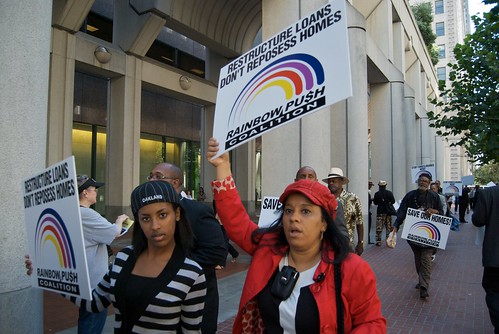
Foreclosure protest at San Francisco Federal Reserve Bank by Steve Rhodes


Friday, July 2, 2010

foreclosure victims

New YorK (CNNMoney.com) - Mortgage borrowers hurt by the Gulf oil spill may qualify for temporary relief from paying their mortgages, without fear of losing their homes.


Citigroup's CitiMortgage unit announced Wednesday that it would suspend all foreclosure sales and filings for 90 days, through Sept. 17, on its Gulf properties. The policy applies only to first mortgages on homes that are within 25 miles of the coast.


Fannie Mae, the government-supported mortgage company, also touted its own relief policy Wednesday, saying that servicers of Fannie-backed loans may immediately suspend or lower payments on mortgages for borrowers whose income or property were affected by the spill.


"This was a reiteration of special relief policies that Fannie Mae has had for a while," said Janis Smith, a spokeswoman for Fannie.


"Borrowers who hope to obtain relief under this policy should call their servicers right away," Smith said. "They should not sit around waiting for a call."


Under the Fannie Mae program, servicers can offer to postpone or lower payments for up to 90 days, during which the servicer is expected to verify the borrower's income loss or the damage the oil spill may have done to their property.


Freddie Mac, the other government-supported mortgage giant, will grant up to six months forbearance to victims of the oil spill.


Full story


And another also relevant to the "foreclosure anxiety" case of Faisal Shahzad:


Fitzgerald: "Nut cases" and learning from experience


Jihad Watch Board Vice President Hugh Fitzgerald discusses a case of a non-Muslim Westerner learning from experience -- and ponders why such cases are so rare among Western dhimmis.


On NPR recently I heard the mellifluous Robert Siegel -- so mellifluous that he punches above his weight, and one is disinclined to pluck out his idiocies because he is well-spoken -- describe a friend of his who had had relatives, or his own friends, die in the World Trade Center Attacks. That friend, hitherto an opponent of capital punishment, had described to Siegel his own new-found willingness not merely to contemplate, but to wish with his own hands to execute, the death penalty on Moussaoui, Osama Bin Laden, and the others he connected to that attack.


So, Siegel's friend turns out to be a former death-penalty opponent who begins to see the matter differently because of his close ties to the victims of murder. He is one more of those souls who have a limited imagination, and who must endure experiences himself in order to learn from them; anything that might be learned, through the experiences of others, recorded and accessible to others, will not do it. The imaginative sympathy, a faculty once encouraged by literature and the study of history, is merely vestigial in him. But still, at least he was able, this friend, to arrive at some home-truths, while there are some who not only lack the wit to learn from the experience of others (as found in works of history and, often, of literature) but even lack the wit to learn from their own experience. For there are now many who continue to interpret away, in ways that prove most comforting to them, even the evidence of their own senses.


Siegel goes on to tell us that his friend describes Moussaoui as a "nut case." That, of course, is nonsense. Had Siegel's friend, had Siegel himself, had others at NPR, taken it upon themselves -- and a certain leisure is required for this task -- to study Islam and jihad and to think clearly about how such belief-systems can operate, none of them would think Moussaoui was anything but sane. Here one must not think of the local etiolated church service, but rather of the kind of indoctrination given to those admitted to the Army of True Communists (in the early days), or True Nazis (at any time).


Moussaoui is not a "nut case." He is a perfectly rational and devout believer in what the Qur'an, and the Sunna, tell him. And he is not unusual in his understanding of what Qur'an and Sunna stand for, of the hostility, even murderous hostility, those immutable texts teach Muslims to feel toward all Infidels. Unless Robert Siegel is willing to study those texts, those of Qur'an and Hadith, and the life of Muhammad, he has no business assuming, and passing on that assumption to unwary listeners, that Moussaoui must, of course, be a "nut case." For there are tens or even hundreds of millions of Believers who, like Moussaoui, divide the world uncompromisingly between Believer and Infidel, between the Domain of Islam, Dar al-Islam, and the Domain of War, or Dar al-Harb, and are perfectly aware of the duty imposed on them to push back the boundaries of Dar al-Harb until, ultimately, the rule of Islam is established everywhere. This is not a fabrication of perfervid mad-dog Infidel brains. It has been studied, at great length, by a great many Western scholars -- the scholars who lived and wrote and published in an earlier, less frightened and less inhibited age. Many of these scholars are represented in the anthology "The Legacy of Jihad." Islam has not changed. What has changed, since 1973, is the wherewithal that Islamic peoples and polities have acquired, including the nearly ten trillion dollars in OPEC oil revenues, and the other instruments of Jihad, including the foot-soldiers, the millions of Muslims who, in roughtly the same period, were admitted into, and allowed to settle deep within, the countries of Western Europe -- that is, within the Lands of the Infidels, behind enemy lines, as Muslims (but not those innocent Infidels) regard them.


There are millions who may not do as Moussaoui (who grew up in France) has done, but who support what he did, and who understand perfectly what prompted it. And it was not a matter of his being a "nut case." It is Moussaoui, and Osama bin Laden, and all the members of Jaish-e-Muhammad, and Laskar Jihad, and Hamas, and Hezbollah, and Al Qaeda, and As Sayyaf, and a thousand other groups, and millions who belong to no groups, who have the Qur'an and the Hadith and the example of Muhammad on their side. Unless and until a great many more people cease to soothe themselves with the comforting idea that all these people are merely "nut cases," and begin to look at, and to study with comprehension the Qur'an, and also -- this should never be overlooked -- the still more telling Hadith, they will continue to be surprised by a steady stream of such “nut cases.”


Mere reading of the Qur'an will not be enough. In both French and English it is far softer in its meaning than the original. And the reader may not be aware that Islamic tradition has resolved contradictory statements using the interpretative device of "naskh" or abrogation, resolving them always and everywhere in favor of the harsher verses, with the softer ones being cancelled.


And even reading and rereading the Qur'an and the most authoritative collections of the Hadith, and then studying the most salient aspects of the life of Muhammad, uswa hasana, al-insan al-kamil, that Perfect Man, will not be enough. It takes time for it all to sink in -- and to imagine, to begin to comprehend, the effect it has on the minds of hundreds of millions, and even how the effect of filial piety, or civilizational pride, can cause otherwise intelligent people born into Islam to accept the monstrousness of it all, and to defend it and apologize for it in front of questioning and skeptical Infidels.


But let us pretend that Moussaoui, and tens of millions of others, are merely "nut cases." Suppose that were true. Suppose, that is, that only "nut cases" would take the passages of Islam and seek to act on them as Moussaoui did. And suppose, further, that the only thing we Infidels had to worry about were acts of terrorism, and not the slow transformation of our own societies (beginning with the sudden self-imposed limits on the practice of freedom of speech, by almost the entire American press, and now even by that supposed total iconoclast and brave disrespecter of all pieties, Comedy Central).


What then? How many "nut cases" are there? Well, the problem is that in any society, millions and millions of people at one time or another fall into depressions. In the United States, more than 15 million people at any one time are said to be severely depressed. When this happens to Infidels, they can blame all sorts of things: their parents, their children, their siblings, Amerika, The System, The Man, the Republicans, the Democrats, immigration, affirmative action, lack of affirmative action, crooked financial analysts, Wall Street speculators, Chinese and Indian competition, Fate, the stars in their alignment, their cholesterol level, their serotonin level -- even, at times, themselves.


What happens when a Muslim finds himself in disarray? You are Muhammad Atta, and things are not working out in Hamburg, where you set off to study urban planning, and you are not the great success you were supposed to be, and the Western world is so baffling, so confusing. You are Raed Albanna, dancing the night away in cocaine-soaked clubs of West Hollywood, and you are piling failure upon failure, for you failed to establish a practice as a lawyer in Jordan, and you need to find a solution more permanent and steady than that offered by that cocaine, those girls, that music by Nine Inch Nails.


When "Mike" Hawash, an Intel engineer with an American wife and three American children, earning $360,000 a year and the respect of his colleagues, turned to Islam and more Islam, and then deeded over his house to his wife, and made plans to fight the Americans in Afghanistan after the Al Qaeda attacks in New York and Washington, was he a "nut case"? Or was he someone who, in his recent return to Islam, was only reflecting his need for Islam and more Islam as a stay against confusion and depression? And if the Answer for Muslims, even those who are not especially observant, and who seem to be thoroughly Westernized and to have been the recipients of the best the West has to offer, is Islam and more Islam, then the Western world, the world of Infidels, owes it to itself to protect its own legacy, and to scrutinize closely and carefully control the immigration of those who, in moments of the kind of doubt or depression that come upon all of us, will always and everywhere turn, or return, to Islam.


[Posted by Hugh on April 16, 2006]


natural penis enlargement

 by kdstevens23